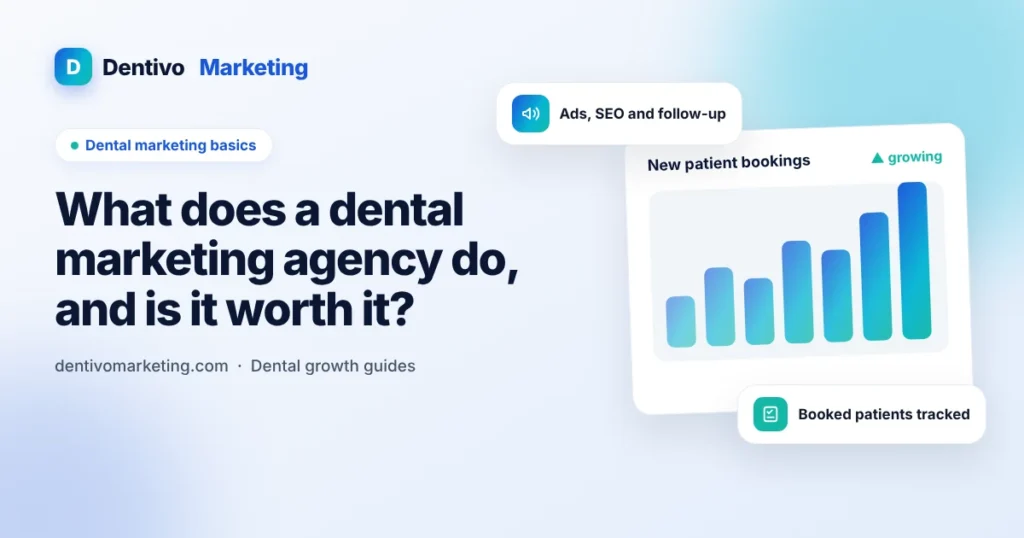
A dental marketing agency brings new patients into your clinic and gets them booked. It runs your ads, ranks you in local search, builds a website that turns visits into appointments, and follows up with every enquiry. It’s usually worth it when the agency works only with dental practices and reports on booked patients, because generic agencies tend to chase clicks and likes that never end up in a chair.
So what results are realistic? A steady rise in new patient bookings, a cost per new patient that drops over the first few months, and more enquiries for implants, aligners and cosmetic work. Paid campaigns, like the Google and Meta ads we run for dental clinics, can start producing calls within a few weeks.
SEO moves slower. Good local SEO for dental clinics usually takes 3 to 6 months to show real movement in the map pack, and then it keeps paying you back long after the work is done.
And all of that traffic lands somewhere. A fast, clear conversion website is where dental website conversion gets won or lost. If you want a second opinion on your own numbers, you can book a free growth call and we’ll go through them with you.
The short answer
- A dental marketing agency handles patient acquisition: ads, local SEO, your website, reviews and follow-up.
- It’s worth it when the agency knows dentistry, tracks booked appointments and shows you the numbers every month.
- Paid ads can work in weeks. SEO builds over months.
- Results depend on your city, your competition, your budget and how fast your front desk answers the phone.
What is a dental marketing agency?
A dental marketing agency is a marketing company that helps dental practices attract, convert and keep patients. The good ones work only with dentists.
That focus matters more than it sounds. A hygiene patient and a full-arch implant patient search differently and take very different amounts of time to decide. One books the same day. The other might read reviews for 3 weeks, ask about financing, and visit your site 6 times before calling.
A specialist agency builds campaigns around those differences. A generalist usually builds one campaign called “dentist” and hopes for the best.
What does a dental marketing agency actually do?
Most clinics need 6 jobs covered. Some agencies do one or two. A full-service partner handles all of them and connects the data so you can see which job is producing patients.
Paid advertising on Google and Meta
Google Search ads catch people who are already looking: “emergency dentist near me,” “dental implants cost,” “Invisalign consultation.” Meta ads (Facebook and Instagram) reach people who aren’t searching yet but fit the profile for cosmetic or orthodontic work.
A good dental advertising agency builds separate campaigns per treatment, adds negative keywords so you don’t pay for “dental school” or “free dentist jobs,” and tracks calls and form fills back to the ad that produced them.
Local SEO and your Google Business Profile
When someone types “dentist near me,” Google shows 3 clinics on a map before any regular results. That map pack is where a big share of new patient calls start.
Google says local rankings depend on relevance, distance and prominence. Your agency can’t move your building, but it can work hard on the other two: categories, services, photos, reviews, location pages and local links.
Conversion websites
Your website has one job. Get the visitor to call or book.
That means fast load times on a phone, a click-to-call button that’s always visible, online booking, clear treatment pages, and real photos of your team and clinic. Fast and clear wins the booking.
Reputation management
Patients read reviews before they read anything else. Reputation work means asking happy patients for reviews at the right moment (usually by text, right after the visit) and replying to every review in a way that respects patient privacy.
Lead nurturing and CRM
Not everyone books on the first contact. Implant and orthodontic patients often need 2 or 3 touchpoints. A CRM tracks every enquiry, sends reminders to your team, and follows up by text and email so warm leads don’t go cold in a spreadsheet.
Analytics and reporting
This is the part that keeps everyone honest. Call tracking, form tracking and booking data should roll up into one monthly report that answers a simple question: how many new patients did we get, and what did each one cost?
Why do generic marketing agencies fall short for dental clinics?
We’ve taken over plenty of accounts from generalist agencies. The same problems show up again and again:
- They report the wrong numbers. Impressions, clicks and followers look good in a slide deck. You can’t pay your associate with them.
- They don’t know the rules. Dental advertising is regulated. Ontario dentists answer to the RCDSO, UK practices to the GDC and the ASA codes, and US practices to their state dental board plus FTC rules on reviews and endorsements.
- They treat every patient the same. One budget, one landing page, one message. High-value cases get buried under cheap clicks.
- They ignore what happens after the click. If calls go to voicemail at lunch, the best ads in the world won’t help.
- They miss local context. Things like the Canadian Dental Care Plan (CDCP) change who’s searching and what they search for. A generalist probably won’t adjust for it.
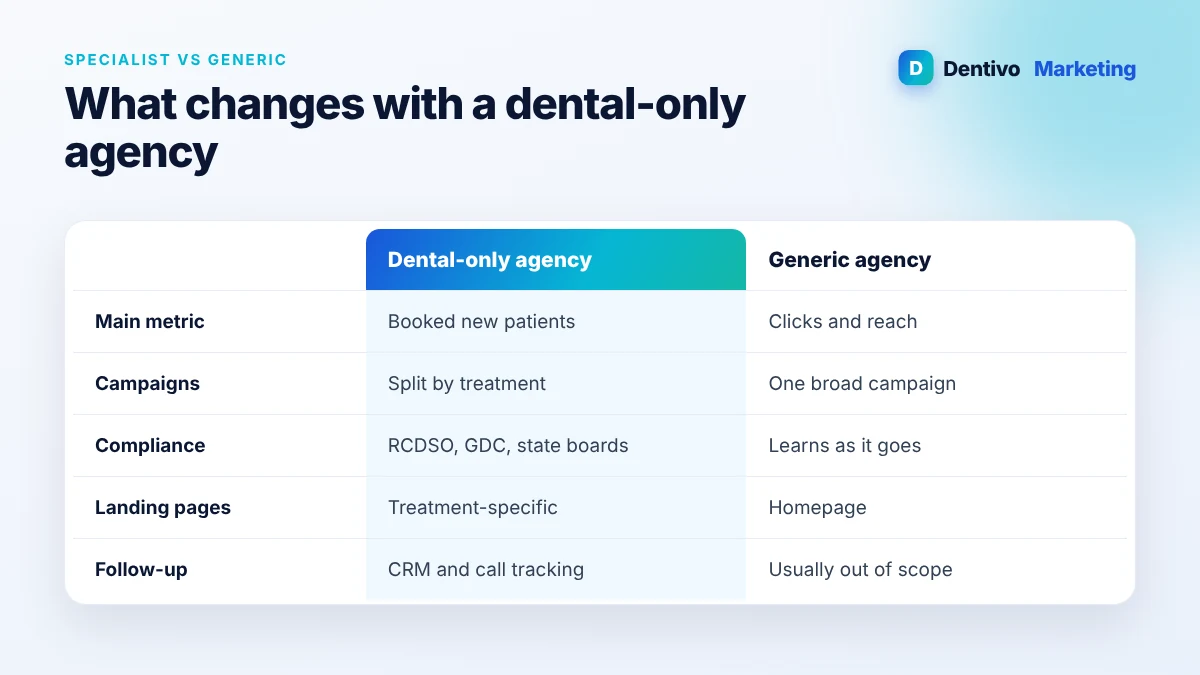
Specialist vs generic agency: how do they compare?
| Area | Dental-only agency | Generic agency |
|---|---|---|
| Main metric | Booked new patients and cost per new patient | Clicks, impressions, reach |
| Campaign structure | Split by treatment (implants, ortho, emergency, family) | One broad “dentist” campaign |
| Compliance | Knows RCDSO, GDC and state board rules | Learns as it goes |
| Landing pages | Treatment-specific, built to book | Homepage or generic template |
| Follow-up | CRM, text reminders, call tracking | Usually outside their scope |
| Ramp-up time | Short, because the playbook exists | Longer, learning on your budget |
For patient acquisition for dentists, the specialist usually wins on speed and on cost per patient. Generalists can still be a good fit for branding or design projects.
Is a dental marketing agency worth the investment?
Short answer: it’s worth it when the math works on booked patients, and it’s easy to check.
Start with what a new patient is worth to you over 2 or 3 years. A family patient who comes back for hygiene, fillings and maybe a crown is worth a lot more than one visit. A single implant or full-arch case can be worth more than months of routine appointments.
Then compare that number with your cost per new patient. If the gap is healthy and the trend is improving, the agency is paying for itself. If the agency can’t tell you your cost per new patient, that’s your answer too.
When it’s usually worth it
- You have open chair time or a new associate to keep busy.
- You want more of a specific treatment, like implants, Invisalign or veneers.
- Your team can answer calls fast and follow a simple booking script.
- You’re willing to give paid ads 60 to 90 days and SEO 6 months or more.
When it probably isn’t (yet)
- You’re already fully booked and can’t take more patients.
- Calls regularly go unanswered and there’s no plan to fix it.
- You expect a fully booked schedule in 2 weeks.
That second list is fixable. Most of the time it’s a staffing or process issue, and a good agency will tell you that before taking your money.
What are the most common myths about dental marketing?
Myth: “Marketing just means running ads.”
Ads are one piece. Clinics that grow steadily usually combine paid traffic with local SEO, reviews and fast follow-up. Ads bring the visitor. The rest decides whether they book.
Myth: “SEO is dead because of AI search.”
Google still shows a local map pack for “dentist near me,” and AI answers pull from the same signals SEO builds: clear service pages, consistent business details, reviews and helpful content. Structured, question-based content is how clinics show up in AI answers in the first place.
Myth: “More leads always means more patients.”
Cheap leads can be the most expensive thing you buy. If half of them never answer the phone, your real cost per patient doubles. Quality and speed to follow-up matter more than raw volume.
Myth: “A big agency is safer.”
Size tells you very little. Ask who’ll actually manage your account, how many dental clients they handle, and whether you’ll see call recordings and booking data. That tells you far more.
How does a dental marketing agency get started with a clinic?
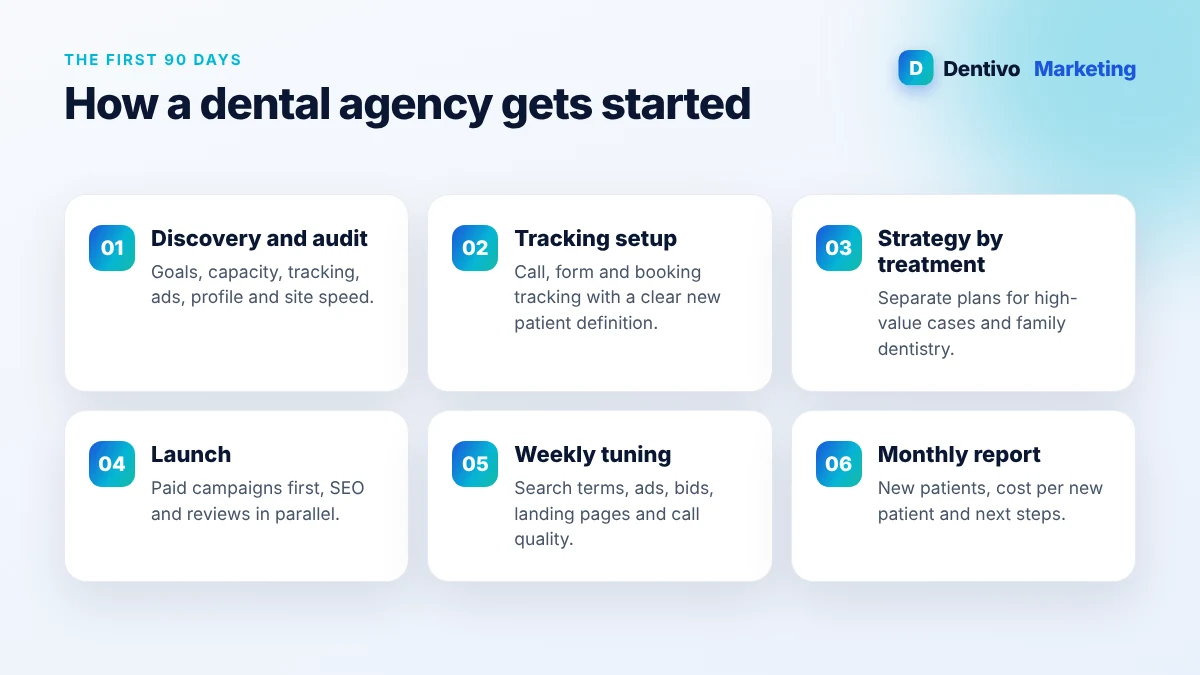
Here’s the process a good agency should follow in the first 90 days:
- Discovery call and audit. Your goals, capacity, best treatments, current tracking, ad accounts, Google Business Profile and website speed.
- Tracking setup. Call tracking numbers, form and booking tracking, and a clear definition of what counts as a new patient.
- Strategy by treatment. Separate plans for high-value cases and for general family dentistry, each with its own budget and landing page.
- Launch. Paid campaigns go live first, since they produce data fastest. SEO and review work start in parallel.
- Weekly tuning. Search terms, ad copy, bids, landing page tests and call quality reviews.
- Monthly reporting. New patients, cost per new patient, booking rate and what’s changing next month.
Where Dentivo Marketing fits
Dentivo Marketing is a dental-only agency. We help clinics in Canada, the USA and the UK attract high-value patients with strategy built on real booking data, and we’ve worked with 240+ clinics across those 3 countries. The goal is simple: keep your chairs full, week after week.
Our core services are Paid Advertising (Google and Meta campaigns), Local SEO, Conversion Websites, Reputation Management, Lead Nurturing and CRM, and Analytics and Reporting. Most clinics use a mix, because the pieces work better together.
We put extra weight on high-value patient marketing for implants, orthodontics and cosmetic dentistry, and our reporting shows booked patients and cost per new patient in plain numbers. In Canada, our campaigns are CDCP-aware. In the UK, our approach follows GDC guidance and the advertising codes. In the US, we work within state board and FTC rules.
If you’re comparing options and wondering who the best dental marketing agency for your clinic is, a short call usually answers it. You can request a free, no-obligation growth call at dentivomarketing.com, or email hello@dentivomarketing.com with your questions.
A note on results: marketing outcomes vary by market, competition, budget, clinic capacity and how enquiries are handled. Any agency that guarantees a specific number of patients without seeing your data is guessing.
Frequently asked questions
How much should a dental clinic spend on marketing?
There’s no single right figure. Clinics usually set a budget based on growth goals, local competition and patient value, then adjust it based on cost per new patient. Start with what you can sustain for at least 3 months, since paid campaigns need that long to settle.
How long before a dental marketing agency gets results?
Paid search can produce calls in the first few weeks, with steadier results by month 2 or 3. Local SEO usually needs 3 to 6 months for visible ranking gains, and longer in very competitive cities.
What’s the difference between a dental SEO agency and a full-service agency?
A dental SEO agency focuses on organic rankings, map pack visibility and content. A full-service agency adds paid ads, websites, reviews, CRM and reporting, so one team can see how every channel contributes to booked patients.
Can a marketing agency help a clinic get more implant patients?
Yes. Implant marketing works best with dedicated campaigns, a detailed treatment page, financing information, before-and-after content that follows local rules, and a follow-up sequence for patients who need more time to decide.
What should I ask before hiring a dental marketing agency?
Ask how they define a new patient, who manages your account, whether you own the ad accounts and website, how they handle compliance in your region, and what a monthly report looks like. Clear answers to those 5 questions tell you most of what you need.
Conclusion
A dental marketing agency is worth it when it’s measured on booked patients and cost per new patient. Specialists tend to get there faster because they already know the treatments, the patients and the rules. If you want to grow dental practice marketing results without guesswork, start with clear tracking and a partner who shows you the numbers.