Yes, Google Ads are worth it for most dental clinics, as long as campaigns are split by treatment, tracked to booked appointments and managed every week. A well-run account can bring emergency, implant and Invisalign calls within the first few weeks, which is something SEO can’t do that fast. The clinics that lose money usually paid a generalist for broad clicks that never turned into patients, and that gap is exactly what a specialist dental advertising agency closes.
The ad is only half of it. Every click should land on a fast, treatment-specific page with one clear action, and that’s why conversion-focused landing pages often decide whether an account is profitable.
Ads also work better alongside organic visibility. Clinics that show up in both the ads and the map pack tend to get more clicks overall, so local SEO for dental clinics is a natural partner to paid search.
At Dentivo Marketing, we judge every campaign on cost per new patient. If you want us to look over your current account, you can book a free growth call and we’ll show you where the budget is going.
The short answer
- Google Ads are worth it when you track every lead through to a booked patient.
- Search campaigns for high-intent treatments usually perform best.
- Expect useful data in 2 to 4 weeks and steadier results by month 2 or 3.
- Most wasted spend comes from broad keywords, missing negatives and weak landing pages.
How do Google Ads work for dental clinics?
Google Ads is a pay-per-click platform. You bid on searches like “emergency dentist near me,” and you pay when someone clicks your ad.
Google sets your position using your bid, your Quality Score (how relevant your ad and landing page are to the search) and the expected impact of assets like call buttons and location details. A relevant ad with a good page can beat a bigger budget.
For dentists, the main appeal is intent. Someone typing “tooth pain open Saturday” is ready to book today. Few other channels catch patients at that exact moment.
When are Google Ads worth it for a dental practice?
- You have open chair time, or a new associate or hygienist to keep busy.
- You want more of a specific treatment, like implants, aligners, veneers or emergency visits.
- Your SEO is still building and you need patients now.
- Your front desk can answer calls quickly and book on the spot.
- You’re willing to track results properly with call tracking and booking data.
When might Google Ads not be worth it?
- You’re already booked out for weeks.
- Calls regularly go to voicemail during business hours.
- Your website is slow, broken on mobile or has no booking option.
- You can’t commit to at least 2 to 3 months of testing.
Each of these is fixable. We’d usually fix the website or the phones first, then launch ads, because sending paid traffic into a leaky process is the fastest way to waste budget.
Which Google Ads campaign types work best for dentists?
Search campaigns
These are the workhorse. Text ads on Google results for specific searches. Build one campaign per treatment (emergency, implants, Invisalign, cosmetic, family) so each gets its own budget, keywords and landing page.
Performance Max
Performance Max shows your ads across Search, Maps, YouTube and more, using Google’s automation. It can work for clinics with clean conversion tracking. Without good tracking, it tends to chase cheap, low-quality leads, so we use it carefully and usually after Search is working.
Local Services Ads
In markets where they’re available for dentists, Local Services Ads appear above regular ads and charge per lead. They can be a useful extra channel, though you have less control over targeting.
Remarketing
Google limits personalized advertising around health topics, so remarketing for dental clinics needs care. Keep it general (brand awareness, clinic tour videos) and stay within Google’s healthcare and personalized ads policies.
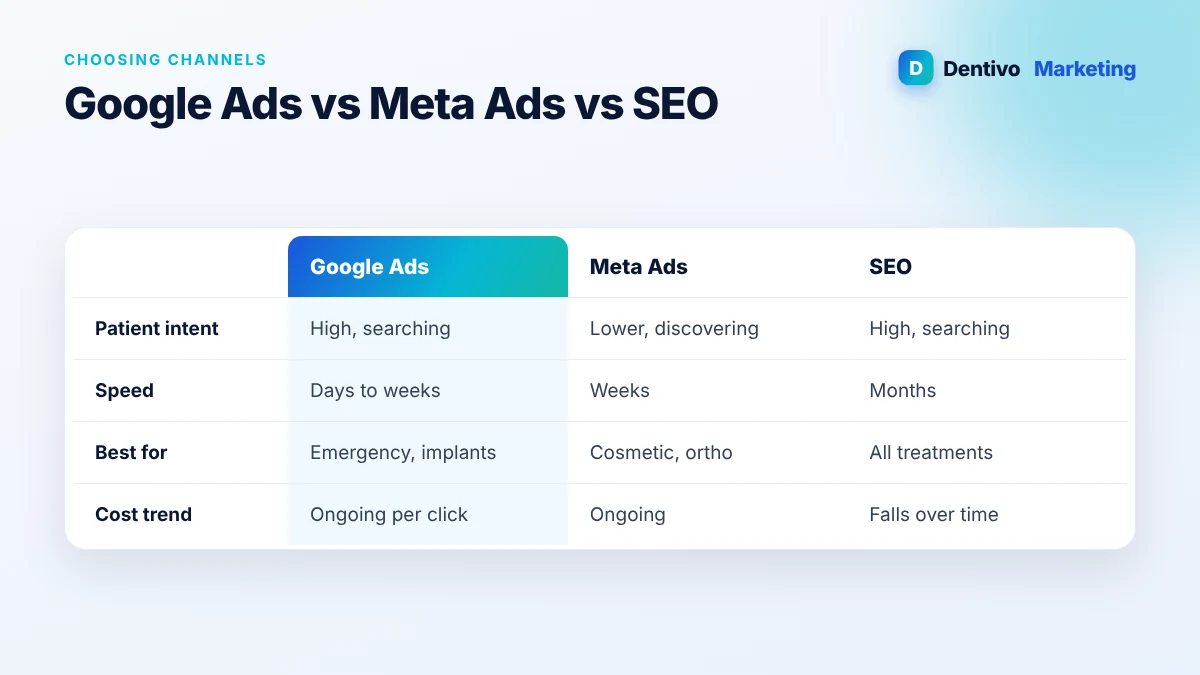
Google Ads vs Meta Ads vs SEO: which is better for dentists?
| Google Ads | Meta Ads | SEO | |
|---|---|---|---|
| Patient intent | High, actively searching | Lower, discovering | High, actively searching |
| Speed | Days to weeks | Weeks | Months |
| Best treatments | Emergency, implants, Invisalign | Cosmetic, whitening, ortho | All, especially family dentistry |
| Cost trend | Ongoing per click | Ongoing per impression or click | Falls as rankings grow |
| Stops when you stop paying? | Yes, immediately | Yes, immediately | Fades slowly |
The strongest setups use all 3. Google Ads for patients ready now, Meta for patients thinking about elective work, and SEO for the long-term base.
How do you measure ROI on dental Google Ads?
Clicks and cost per click are the start of the story. These are the numbers that decide profit:
- Cost per lead: total spend divided by calls, forms and bookings.
- Booking rate: the share of leads that book an appointment.
- Show rate: the share of booked patients who actually arrive.
- Cost per new patient: spend divided by new patients who attended.
- Patient value: what an average new patient from that campaign is worth over 2 to 3 years.
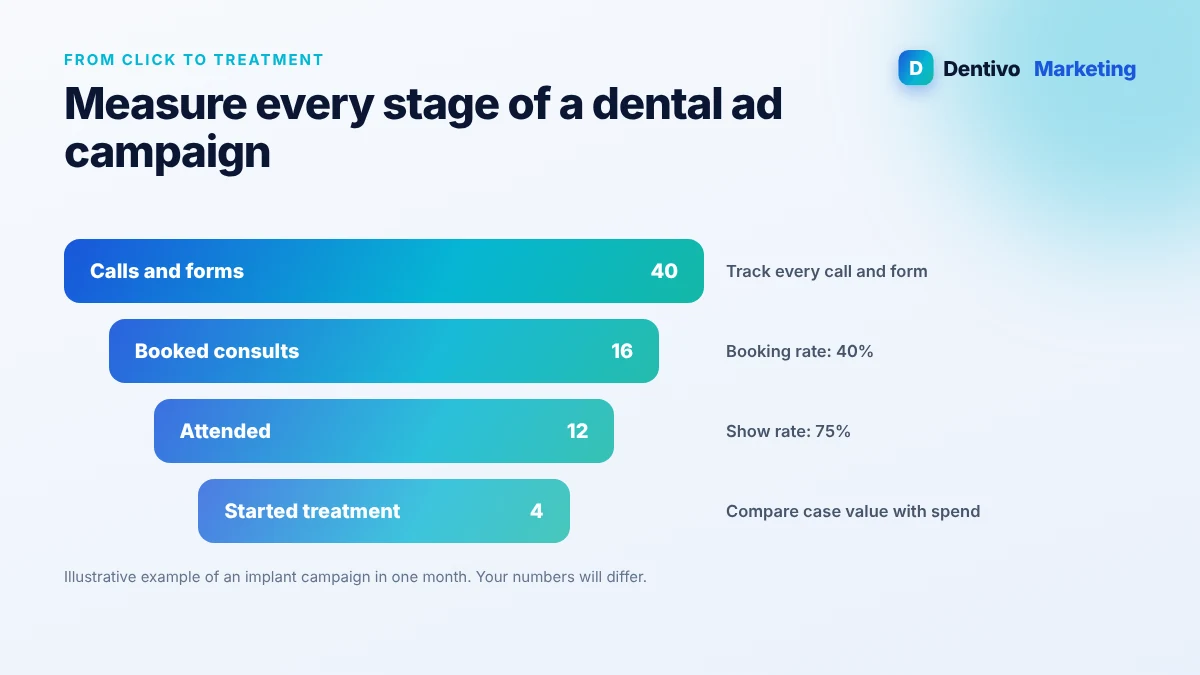
Here’s a quick example with no dollar figures. Say an implant campaign brings 40 calls in a month. Your team books 16 consultations, 12 show up, and 4 go ahead with treatment. The real question is whether those 4 cases are worth far more than the month’s spend. For implant campaigns, they usually are. For a weak campaign with a 10% booking rate, the math falls apart fast.
That’s why call tracking and booking data matter so much. Without them, there’s no way to know if your ads are profitable.
What are the most common Google Ads mistakes dental clinics make?
- Using broad match without guardrails. Your ad shows for “dental hygienist jobs” and “free dental clinic.”
- Skipping negative keywords. A good dental account often has hundreds.
- Sending every click to the homepage. Treatment searches need treatment pages.
- Not tracking calls. Most dental leads phone in. If calls aren’t tracked, your data is mostly blind.
- Targeting too wide an area. Patients rarely travel 40 minutes for a filling.
- Running ads 24/7 with no one to answer. Schedule ads around your phone coverage, or use online booking for after-hours.
- Letting automation run unchecked. Automated bidding needs good conversion data and regular review.
What should a dental ad landing page include?
A landing page for paid traffic has one job: turn a click into a call or a booking. Here’s our checklist:
- A headline that repeats the treatment and the area, like “Dental implants in North York.”
- A tap-to-call button and a booking button in the first screen on mobile.
- 3 to 5 short answers to the questions patients ask most (pain, time, recovery, payment options).
- Real photos of your clinic and team.
- Recent reviews, shown in a way your regulator allows.
- A short form with 3 or 4 fields at most.
- Load time under 3 seconds on a normal phone connection.
We’ve seen the same ad budget produce very different results just from swapping a homepage for a page like this.
What myths do dentists believe about Google Ads?
Myth: “Google Ads are a money pit.”
Badly run accounts are. A tightly built account with good tracking is one of the most predictable patient sources a clinic can have.
Myth: “We need to be in the top spot.”
Position 2 or 3 often brings patients at a lower cost. Being first for every search can burn budget for very little extra return.
Myth: “More clicks means more patients.”
Only if the clicks come from the right searches and land on a page that books. A smaller number of high-intent clicks usually wins.
Myth: “Once it’s set up, it runs itself.”
Search terms change, competitors adjust bids and costs move. Accounts need weekly attention to stay profitable.
How should a dental clinic set up Google Ads?
- Pick 2 to 4 priority treatments and set a budget for each.
- Build one Search campaign per treatment with tightly themed ad groups.
- Write ads that mention the treatment, your location and a clear next step.
- Add call, location and sitelink assets.
- Create a matching landing page for each campaign.
- Set up conversion tracking for calls, forms and online bookings.
- Review search terms weekly and add negatives.
- Report monthly on cost per new patient, then shift budget toward the winners.
What advertising rules apply to dental ads?
Dental advertising is regulated, and the rules differ by region.
- Canada: provincial regulators like the RCDSO in Ontario and the CDSBC in British Columbia set standards on claims, specialist titles, testimonials and before-and-after images. If you mention the CDCP, make sure your clinic actually participates.
- UK: the GDC expects advertising to be honest and not misleading, and the ASA’s CAP code applies to all ads. Only dentists on a GDC specialist list can call themselves specialists.
- USA: state dental boards set their own rules, and the FTC regulates endorsements and fake reviews. HIPAA affects how you handle patient data in forms and tracking.
Google also has its own healthcare policies. A dental marketing agency that works in these markets every day will build compliance into the ads from the start.
Working with Dentivo Marketing on paid ads
Dentivo Marketing is a dental-only agency helping clinics in Canada, the USA and the UK attract high-value patients, using strategy grounded in real booking data. We’ve worked with 240+ clinics across those 3 countries, and the goal is always the same: chairs filled consistently.
Paid Advertising (Google and Meta campaigns) is one of our core services, alongside Local SEO, Conversion Websites, Reputation Management, Lead Nurturing and CRM, and Analytics and Reporting. Our campaigns put extra focus on implants, orthodontics and cosmetic dentistry, which is where high-value patient marketing pays back most.
We share reporting you can read in a few minutes: new patients, cost per new patient and what we’re changing next. Canadian campaigns are CDCP-aware, UK campaigns follow GDC guidance, and US campaigns respect state board and FTC rules.
If you’re looking for the best dental marketing agency for paid ads, start by asking how they measure success. We’re happy to answer that on a free, no-obligation growth call. Visit dentivomarketing.com or email hello@dentivomarketing.com.
A note on results: ad performance varies by market, competition, budget, season and how leads are handled. The example in this article is illustrative and doesn’t predict results for any specific clinic.
Frequently asked questions
How much should a dentist spend on Google Ads?
It depends on your city, competition and goals. Start with a budget you can hold steady for at least 3 months, focused on 2 to 4 treatments, then adjust based on cost per new patient.
How long does it take for dental Google Ads to work?
Many clinics see calls in the first 1 to 2 weeks. Campaigns usually need 4 to 8 weeks of data before performance settles and becomes predictable.
Are Google Ads better than SEO for dentists?
They do different jobs. Google Ads bring patients quickly and stop when spending stops. SEO takes longer but lowers cost per patient over time. Most clinics do best with both.
What keywords should a dental clinic bid on?
Focus on high-intent, treatment-specific terms with a location, such as emergency dentist, dental implants, Invisalign and same-day crowns near your clinic. Avoid broad terms that attract job seekers or people looking for free care.
Should I hire a dental SEO agency or a paid ads specialist?
If you need patients in the next 90 days, start with paid ads. If you want lower costs long term, invest in SEO. A full-service dental SEO agency that also runs ads can coordinate both and report on patient acquisition for dentists as one picture.
Conclusion
Google Ads are worth it for dentists when campaigns are built by treatment and judged on booked patients. Fix your landing pages and phone handling first, then let the data guide your budget. Done well, paid search is one of the most reliable ways to grow dental practice marketing results and improve dental website conversion at the same time.