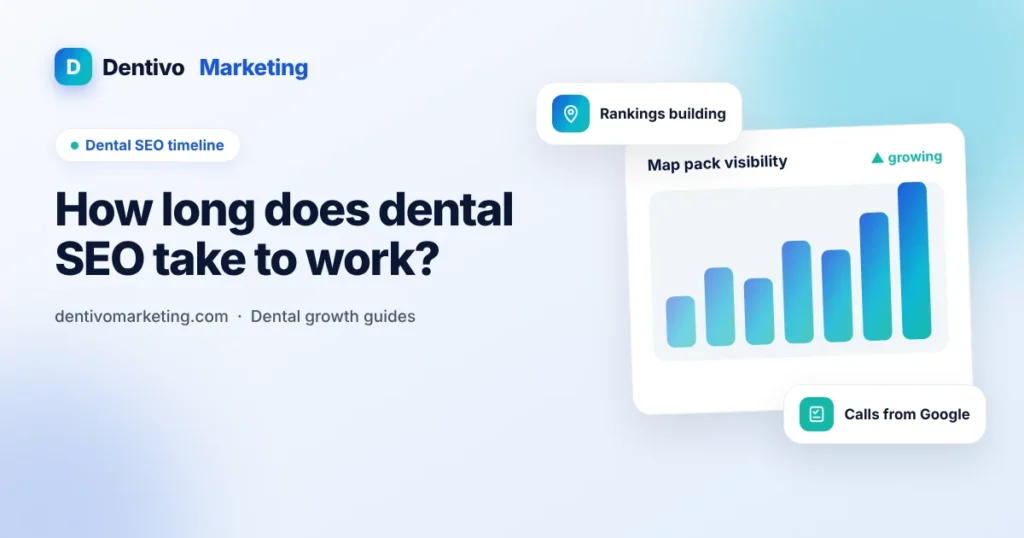
Dental SEO usually takes 3 to 6 months to show clear gains, and 6 to 12 months to reach strong positions in competitive cities. Early signs like more profile views and calls from your Google Business Profile often appear within the first 60 to 90 days. A specialist dental SEO agency tends to get there faster than a generic one, because it already knows which treatment pages, categories and local signals move the needle for clinics.
The timeline depends on your starting point. A clinic with an old domain, 200 reviews and a complete profile will move faster than a new clinic with a fresh website. That’s normal, and any honest dental marketing agency will tell you where you’re starting from before promising anything.
Your website matters here too. Google rewards pages that load fast and answer questions clearly, and those same pages turn visitors into bookings, which is why a conversion-focused dental website is part of any serious SEO plan.
If you need patients sooner, SEO doesn’t have to work alone. Many clinics run Google ads for dentists while rankings build. You can also book a free growth call to get a realistic timeline for your own market.
The short answer
- First signs: 1 to 3 months (profile views, calls, a few rankings).
- Clear gains: 3 to 6 months in most markets.
- Strong positions in competitive cities: 6 to 12 months or more.
- Results build on each other, so stopping early wastes the work already done.
What is dental SEO?
Dental SEO is the work of getting a dental clinic to appear higher in Google’s map results and regular search results for searches local patients make. Think “dentist near me,” “emergency dentist downtown Toronto” or “Invisalign Manchester.”
It has 2 parts. Local SEO for dental clinics focuses on the map pack and your Google Business Profile. Organic SEO focuses on your website ranking in the regular results below the map. Most new patient calls from search come from the first part, so that’s usually where we start.
What does a typical dental SEO timeline look like?
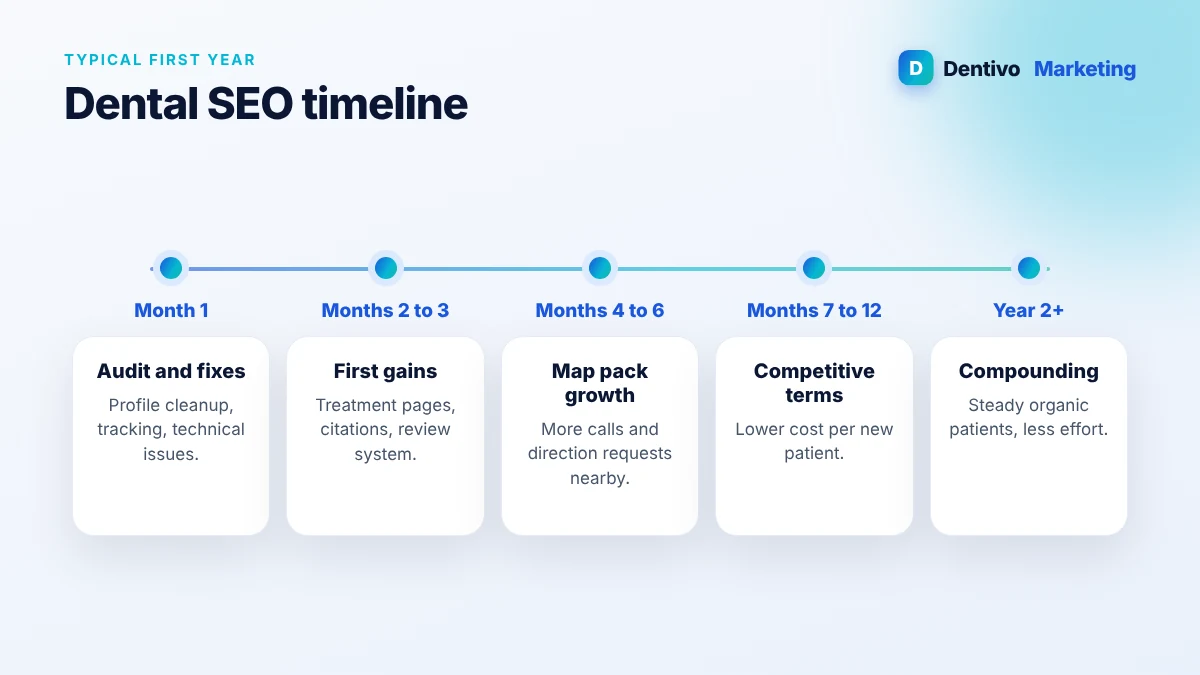
Here’s what a realistic first year often looks like for a clinic starting from an average position:
| Period | What’s happening | What you’ll probably see |
|---|---|---|
| Month 1 | Audit, tracking, profile cleanup, technical fixes | Little change in rankings, better data |
| Months 2 to 3 | Treatment pages, citations, review system, first local links | More profile views, first ranking gains for less competitive terms |
| Months 4 to 6 | Content, location pages, ongoing reviews and links | Map pack appearances in nearby areas, more calls and direction requests |
| Months 7 to 12 | Expansion to more treatments and neighbourhoods | Stronger positions for competitive terms, lower cost per new patient |
| Year 2+ | Maintenance, new content, review growth | Steady flow of organic patients with less effort |
What affects how fast dental SEO works?
Some clinics see map pack gains in 8 weeks. Others need a year. The difference usually comes down to these factors:
- Local competition. Ranking in a busy downtown core is much harder than in a suburb with 4 clinics.
- Your Google Business Profile. Wrong categories, missing services or a suspended profile slow everything down.
- Reviews. Count, recency and rating all play a part in prominence.
- Website history. An older domain with clean links usually moves faster than a brand-new one.
- Technical health. Slow pages, broken links and missing mobile versions hold rankings back.
- Consistent business details. Your name, address and phone number should match everywhere: your site, Google, Apple Maps, Bing, Yelp and dental directories.
- Content depth. A single “services” page listing 20 treatments rarely ranks for any of them, so give each main treatment its own page.
Local SEO vs organic SEO: what’s the difference for dentists?
| Local SEO (map pack) | Organic SEO (website) | |
|---|---|---|
| Where you appear | Google Maps and the 3-pack | Regular results below the map |
| Main levers | Profile, reviews, proximity, citations | Pages, content, links, technical health |
| Typical searches | “dentist near me,” “emergency dentist” | “how long do implants last,” “Invisalign vs braces” |
| Speed | Often faster | Usually slower, wider reach |
| Best for | Calls and walk-ins nearby | Research-stage patients and AI answers |
You need both. Local SEO brings the ready-to-book patient. Organic content catches the patient who’s still deciding, and it’s what AI tools like Google’s AI Overviews tend to quote.
How can a dental clinic speed up SEO results?
- Fix your Google Business Profile first. Correct primary category, every service listed, accurate hours, fresh photos.
- Clean up your citations. Make your name, address and phone match on every directory.
- Build one page per main treatment. Implants, Invisalign, veneers, emergency care, family dentistry, each with real answers.
- Start a weekly review routine. Ask by text after visits and reply to every review.
- Fix technical problems. Aim for good Core Web Vitals: a largest contentful paint under 2.5 seconds is a solid target.
- Earn local links. Community sponsorships, local news, dental associations and partner businesses.
- Publish answers to real questions. Use what your front desk hears every day as your content plan.
Which treatments should a dental clinic rank for first?
Start with the treatments that bring the most value per patient and the ones you actually want more of. For most clinics that’s implants, Invisalign or clear aligners, veneers and emergency care, followed by family and general dentistry.
This is high-value patient marketing applied to SEO. A ranking for “dental implants near me” can be worth far more than a ranking for “teeth cleaning,” even if the cleaning term gets more searches. Pick 3 to 5 priority treatments, build a strong page for each, and expand from there.
Good patient acquisition for dentists through SEO also means matching the search to the right page. Someone searching “chipped tooth repair” should land on a page about bonding or crowns, with a booking button right there.
What role does your website play in dental SEO?
Rankings get the visit. Your website gets the booking.
Strong dental website conversion comes from a few basics: pages that load fast on a phone, a click-to-call button that stays visible, online booking, real photos of your team, and clear answers to the questions patients ask before they call. Those same things help SEO, because Google measures how well a page serves the person who clicked.
We often see clinics doubling down on SEO while their site loses half its visitors in the first 5 seconds. Fixing the site first makes every ranking worth more.
Why do generic SEO agencies struggle with dental clinics?
General SEO skills transfer. Dental knowledge doesn’t come with them.
A generalist might write “best dentist in town” on your homepage, which can break advertising rules in some regions. They might create one page for “cosmetic dentistry” when patients search for veneers, bonding and whitening separately. And they often report traffic, when what you need to know is how many of those visitors called.
Compliance adds another layer. In Ontario, the RCDSO sets rules on advertising, including specialist titles and testimonials. In the UK, GDC guidance and the ASA codes apply. US practices answer to their state board. Your content has to follow those rules, or it becomes a liability.
What are the biggest myths about dental SEO?
Myth: “We can get you to #1 in 30 days.”
No agency controls Google’s rankings. Fast gains for very low-competition terms are possible. Guarantees for “dentist near me” in a big city are a red flag.
Myth: “Repeat the keyword more and you’ll rank.”
Keyword stuffing reads badly and can hurt you. Google looks for pages that answer the search well. Use the term naturally and cover the topic properly.
Myth: “Google Business Profile is all you need.”
It’s the biggest piece for map rankings. Your website still feeds relevance and trust, and it’s where most patients book.
Myth: “AI search means SEO is over.”
AI answers draw on the same signals SEO builds. Clinics with clear, well-structured pages and solid local data get mentioned. Clinics with thin sites get skipped.
How do you measure whether dental SEO is working?
Rankings are a signal. Patients are the result. Track both:
- Calls, website clicks and direction requests from your Google Business Profile.
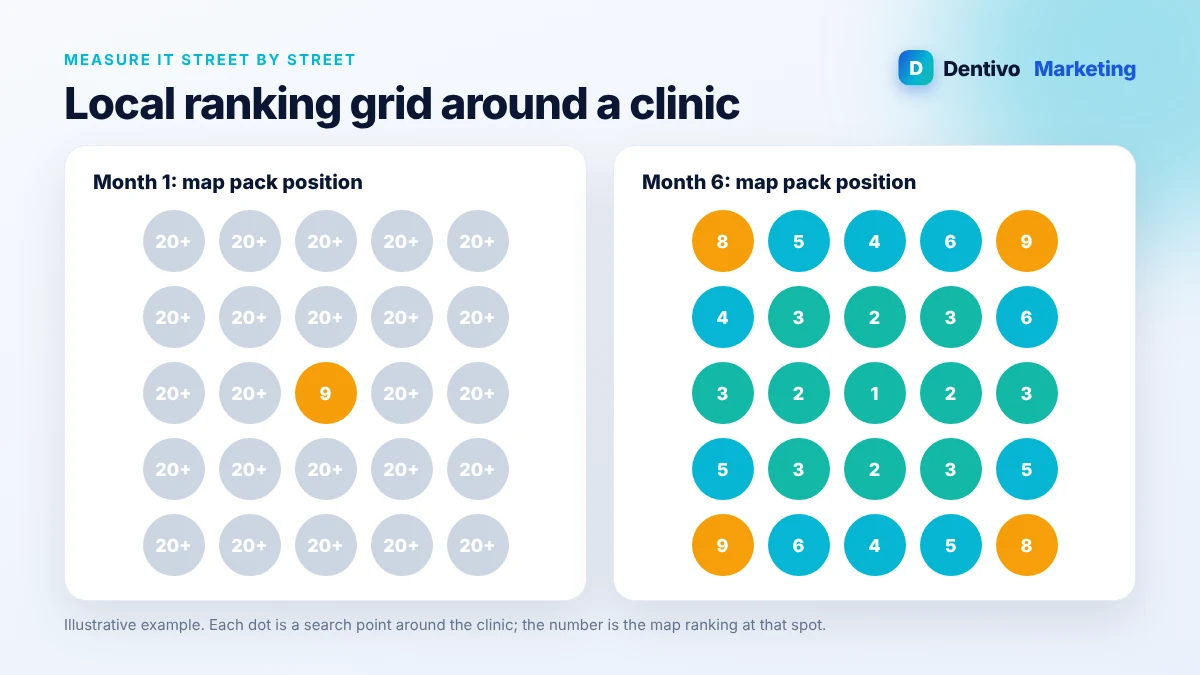
- Map rankings across a grid of points around your clinic, since rankings change block by block.
- Organic traffic to treatment pages.
- Online bookings and form fills from organic visitors.
- New patients who say they found you on Google.
- Cost per new patient from SEO compared with paid ads.
Should you run SEO and paid ads at the same time?
For most clinics, yes. A good dental advertising agency can bring patients through paid ads while SEO builds, and the data from ads tells you which keywords convert best. That’s useful input for your SEO content.
Over time, as organic rankings grow, many clinics can shift some budget away from ads for the terms they already rank well for. That’s how SEO lowers your overall cost per new patient.
How Dentivo Marketing approaches dental SEO
Dentivo Marketing is a dental-only agency helping clinics in Canada, the USA and the UK attract high-value patients through strategy based on real booking data. We’ve worked with 240+ clinics across those 3 countries, and our work is built around one goal: filling chairs consistently.
SEO is one part of what we do. Our core services are Paid Advertising (Google and Meta campaigns), Local SEO, Conversion Websites, Reputation Management, Lead Nurturing and CRM, and Analytics and Reporting. Our SEO work puts extra focus on high-value treatments like implants, orthodontics and cosmetic dentistry, since those pages tend to bring the strongest return.
We report in plain numbers: calls, bookings and cost per new patient, every month. In Canada our content and campaigns are CDCP-aware, in the UK we follow GDC guidance, and in the US we work within state board rules.
Choosing the best dental marketing agency for SEO comes down to proof: ask to see how they track calls and bookings, and how they handle compliance in your region. If you’d like a realistic SEO timeline for your clinic, we offer a free, no-obligation growth call. Visit dentivomarketing.com or email hello@dentivomarketing.com, and we’ll look at your current rankings and competition with you.
A note on results: SEO timelines vary by market, competition, website history and how consistently the work is done. Google’s algorithms change often, so treat any timeline as an estimate.
Frequently asked questions
Why is my dental clinic not showing up on Google Maps?
Common causes are an unverified or suspended Google Business Profile, the wrong primary category, inconsistent business details across directories, few reviews, or strong competitors closer to the searcher. An audit of your profile and citations usually finds the cause quickly.
How much does dental SEO cost?
Pricing depends on how competitive your market is, how many locations and treatments you want to rank for, and how much content and technical work is needed. It’s best to compare proposals on scope and reporting, since cheaper plans often skip the work that moves rankings.
Can I do dental SEO myself?
You can handle the basics: keep your Google Business Profile updated, ask for reviews and post photos. Technical fixes, content at scale, link building and grid tracking are where most clinics bring in help.
What is a good result from local SEO for dental clinics?
A good result is steady growth in calls and bookings from Google, map pack visibility for your main treatments across your service area, and a falling cost per new patient compared with relying on ads alone.
Does dental SEO stop working if I stop paying?
Rankings usually slip slowly as competitors keep working. Reviews, content and links need regular attention to hold your position.
Conclusion
Dental SEO is a 3 to 12 month build, and the clinics that stick with it end up with their lowest-cost source of new patients. Start with your Google Business Profile, treatment pages and reviews, then measure calls and bookings above rankings. Pair it with paid ads early on to grow dental practice marketing results while the long-term work pays off.