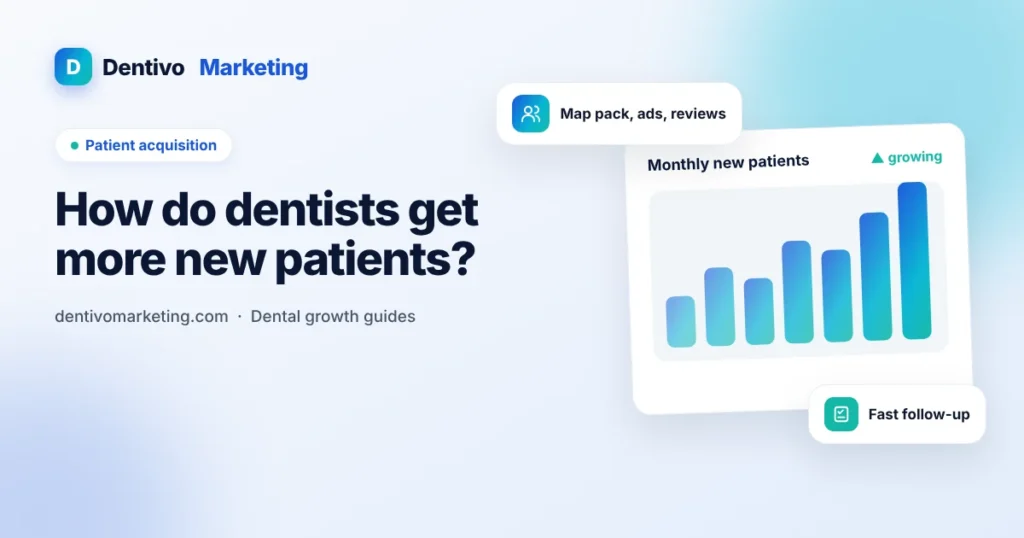
Dentists get more new patients by showing up where local people search, making it easy to book, and following up fast. In practice that means a strong Google Business Profile, treatment-specific Google ads, a website built to convert, plenty of recent reviews, and a front desk that calls every enquiry back within minutes. Clinics that work with a dental-only partner like Dentivo Marketing usually see faster results than with generic agencies, because the campaigns are built around booked appointments.
Here’s what to expect. Paid search can bring calls in weeks. Map pack rankings from local SEO for dentists take a few months, then keep producing patients at a lower cost.
The fastest wins usually come from fixing leaks. Missed calls, slow pages and weak treatment pages cost clinics more patients than bad ads do, and a better conversion website often lifts bookings without spending a cent more on traffic.
Ads still matter, especially for implants, aligners and emergency care. Well-built Google and Meta ad campaigns put you in front of patients the day they decide. And if you’d like someone to look at your current setup, you can book a free growth call and get a plain-English review.
The short answer
- Win the Google map pack with a complete profile and steady reviews.
- Run separate ads for each high-value treatment.
- Send every click to a fast page with one clear booking action.
- Call back every enquiry in under 5 minutes, and keep following up for at least a week.
What is patient acquisition for dentists?
Patient acquisition for dentists is the process of finding, attracting and booking new patients for a dental clinic. It covers every step from the first Google search to the first appointment.
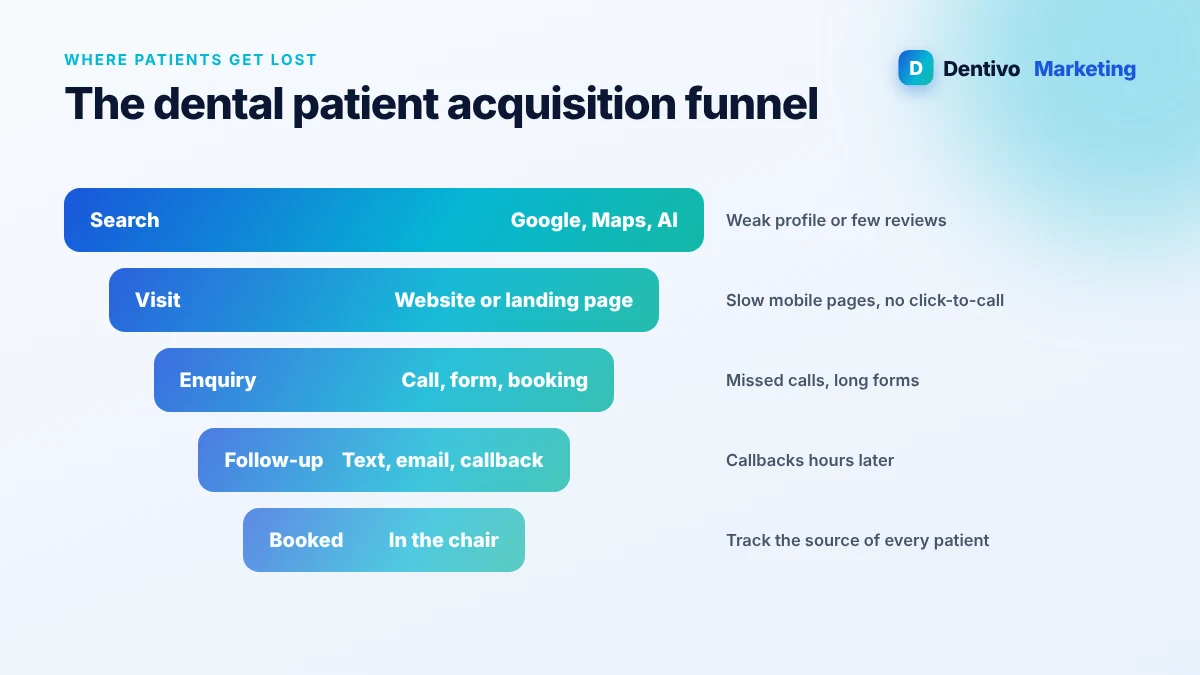
Most clinics only measure the start (clicks, calls) and the end (new patients in the practice software). The middle is where patients get lost. Unanswered calls, forms that sit unread for 2 days, and booking pages that break on a phone.
Why do dental clinics struggle to get new patients?
We hear the same 5 problems from almost every clinic on a first call:
- Too much competition in the map pack. In most cities, 10 or more clinics compete for the same 3 map spots.
- Ads that attract the wrong people. Broad keywords pull in job seekers, students and people looking for free care.
- A website that looks fine but doesn’t book. No click-to-call, no online booking, slow on mobile.
- Few or old reviews. A clinic with 40 reviews from 2021 loses to one with 300 from this year.
- Slow follow-up. Leads come in at 9pm, the callback happens the next afternoon, and the patient has booked elsewhere.
Each of these can be fixed with attention and a simple process, often on the budget you already have.
What are the most effective ways to get new dental patients?
1. Make your Google Business Profile the best on your street
Pick the right primary category (“Dentist,” “Cosmetic dentist,” “Orthodontist”), add every service you offer, upload real photos every month, and keep hours accurate, including holidays. Google ranks local results on relevance, distance and prominence. A complete, active profile helps with 2 of the 3.
2. Run Google Search ads by treatment
Build separate campaigns for emergency, implants, Invisalign, veneers and family dentistry, each with its own budget, ads and landing page. Add call assets and location assets, and check the search terms report every week.
This is where a dental advertising agency earns its keep. The difference between a profitable account and a money pit is often a few hundred negative keywords.
3. Use Meta ads for treatments people plan ahead
People think about cosmetic and orthodontic work for weeks. Facebook and Instagram ads with before-and-after content (where your regulator allows it), short videos from your team, and a simple consultation offer can start that conversation early.
One caution: Meta has tightened health-related targeting and data rules over the past few years. Your setup should account for that, or your tracking will quietly break.
4. Build pages that book
Every treatment you advertise needs its own page. That page should load in under 3 seconds on a phone, answer the top 5 questions patients ask, show real photos, explain financing in general terms, and put a booking button above the fold.
Good dental website conversion is mostly removing friction. Fewer form fields. A visible phone number. Online booking that actually shows open times.
5. Collect reviews every single week
Ask by text, within a few hours of the visit, with a direct link. Reply to every review without confirming any treatment details (that’s a privacy issue in every country we work in). Steady new reviews matter more than a big batch once a year.
6. Answer fast and follow up longer
Lead-response research going back years shows the odds of reaching a lead fall sharply after the first few minutes. So call fast. Then follow up by text and email for 7 to 14 days for anyone who hasn’t booked. A basic CRM handles this without adding work for your team.
7. Look after the patients you already have
Recall reminders, reactivation campaigns for patients who haven’t visited in 18 months, and a simple referral ask all bring in bookings at almost no cost. In Canada, telling existing patients whether you accept the Canadian Dental Care Plan (CDCP) can bring back people who stopped coming because of cost.
8. Answer patient questions so AI search can find you
More patients now ask Google, ChatGPT or Perplexity things like “how long does an implant take to heal” or “is Invisalign faster than braces.” Those tools pull answers from pages that respond clearly and directly.
So write treatment pages and blog posts around the real questions your front desk hears every week. Put the answer in the first 2 sentences, use plain headings, and keep your clinic name, address and phone number identical everywhere online. It’s the same work that helps regular SEO, and it gets your clinic named in AI answers more often.
Which patient acquisition channels work fastest?
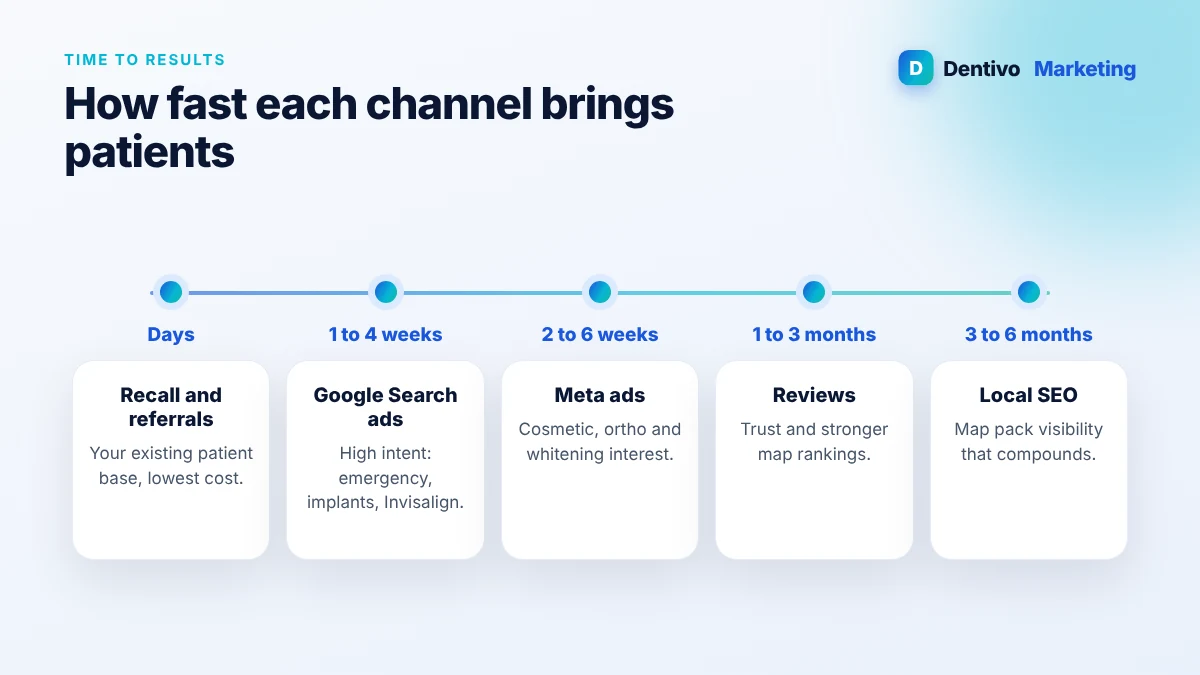
| Channel | Time to first results | Cost over time | Best for |
|---|---|---|---|
| Google Search ads | 1 to 4 weeks | Steady, drops as campaigns mature | Emergency, implants, Invisalign |
| Meta ads | 2 to 6 weeks | Varies with creative | Cosmetic, ortho, whitening |
| Local SEO and map pack | 3 to 6 months | Falls over time | Family and general dentistry |
| Reviews | 1 to 3 months | Very low | Trust and map rankings |
| Recall and referrals | Days | Lowest | Existing patient base |
Most clinics need a mix. Paid ads cover the next 90 days while SEO and reviews build the next 2 years.
How do you attract high-value patients like implant and Invisalign cases?
High-value patient marketing is a different game from general marketing. These patients research longer, compare more clinics and care a lot about trust.
Here’s what tends to work:
- A dedicated page per treatment with real process photos, the steps involved and recovery time.
- Clear, general financing information (payment plans, insurance questions) without listing prices that change.
- Video from your clinic. Even a 60-second phone video of a consultation room beats stock photos.
- A free consultation or assessment offer, framed honestly.
- A follow-up sequence that answers objections over 2 weeks: pain, time, cost, results.
Be careful with claims. Words like “specialist” are restricted in many places, and regulators like the RCDSO in Ontario and the GDC in the UK have rules on testimonials and before-and-after images. Get it wrong and you risk more than a rejected ad.
What myths hold clinics back?
Myth: “Word of mouth is enough.”
Referrals are great, and they still start with a Google search. The friend says “go see my dentist,” and the patient checks your reviews and website before calling. Weak online presence leaks referrals too.
Myth: “We tried Google Ads and it didn’t work.”
Usually the account was set up badly: broad match keywords, no negatives, one landing page, no call tracking. A rebuilt account often performs very differently.
Myth: “SEO is too slow to bother with.”
It’s slower. A clinic that started SEO a year ago is now getting patients at a fraction of its ad cost, and starting later just pushes that date back.
Myth: “Posting on social media gets patients.”
Organic posts help with trust and recall. They rarely bring a steady flow of new bookings by themselves. Paid social with a clear offer is a different story.
A simple 90-day plan to get more dental patients
- Week 1: Audit your Google Business Profile, website speed, call handling and tracking.
- Week 2: Set up call tracking and booking tracking so every new patient has a source.
- Weeks 3 to 4: Launch treatment-specific Google Search campaigns and fix the top 3 website leaks.
- Month 2: Start a weekly review request system and add Meta ads for one cosmetic or ortho offer.
- Month 2 to 3: Publish treatment pages and location content for local SEO.
- Month 3: Review cost per new patient by channel, then move budget toward what’s working.
How Dentivo Marketing helps clinics get more patients
Dentivo Marketing is a dental marketing agency that works only with dental clinics in Canada, the USA and the UK. We’ve helped 240+ clinics across those 3 countries attract high-value patients, with every decision based on booking data. The focus is filling dental chairs consistently, month after month.
Our core services cover the whole journey: Paid Advertising (Google and Meta campaigns), Local SEO, Conversion Websites, Reputation Management, Lead Nurturing and CRM, and Analytics and Reporting. We put extra effort into implants, orthodontics and cosmetic dentistry, and we report patient growth in clear numbers you can check.
Local rules shape everything we do. Canadian campaigns are CDCP-aware. UK campaigns follow GDC guidance. US campaigns respect state dental board rules and FTC standards on reviews.
If you’re trying to work out whether a dental SEO agency or a full-service partner makes more sense, we’re happy to talk it through on a free, no-obligation growth call. You’ll find us at dentivomarketing.com, or you can reach the team at hello@dentivomarketing.com.
A note on results: how fast a clinic grows depends on its city, competition, budget, available chair time and how quickly enquiries are handled. Use any timeline in this article as a general guide, not a promise.
Frequently asked questions
What is the fastest way for a dentist to get new patients?
Google Search ads for high-intent treatments like emergency care and implants are usually the fastest, often producing calls within the first few weeks. Pair them with fast call handling so those calls turn into bookings.
How many new patients should a dental clinic get each month?
It depends on clinic size, number of providers and goals. A better question is whether new patient numbers are growing and whether cost per new patient is stable or falling over time.
Do online reviews really bring in more dental patients?
Yes. Reviews affect map pack rankings and they’re one of the first things patients check. A steady flow of recent reviews tends to help more than a large number of old ones.
Is local SEO for dental clinics worth it for a small practice?
Usually, yes. Local SEO for dental clinics helps small practices compete in their own neighbourhood, and the patients it brings tend to cost less over time than paid traffic.
How do I know which marketing channel is bringing patients?
Use call tracking numbers per channel, track online bookings and forms, and ask every new patient how they found you. Combine those in one monthly report so you can compare cost per new patient by channel.
Conclusion
Getting more dental patients comes down to being visible locally, making booking easy and following up fast. Fix the leaks first, then add paid ads for speed and SEO for long-term growth. If you want to grow dental practice marketing results steadily, the best dental marketing agency for your market is the one that measures booked patients above everything else.