The best dental marketing agency for your clinic is one that works only with dental practices, measures success in booked patients and cost per new patient, knows the advertising rules in your region, and lets you own your ad accounts and data. Specialized agencies usually deliver steadier patient growth because they already know which treatments to push and how dental patients decide. Generic agencies often fall short because they report clicks and reach, which don’t tell you if anyone booked.
Start with what they actually do. A strong partner should be able to show you how its Google and Meta ad campaigns for dentists are tracked from the first click to the first visit.
Ask about the slower channels too. A good agency will explain how its local SEO work for dental clinics builds map pack visibility over months, and it’ll give you a realistic timeline for your city.
Then look at the site your patients land on. If an agency can’t explain how its conversion websites turn visitors into bookings, keep looking. And if you’d like to see what a clear answer sounds like, you can book a free growth call with our team.
The short answer
- Pick a dental-only agency with proof of booked patients.
- Insist on call tracking, booking data and monthly reports you can understand.
- Make sure you own your ad accounts, website and data.
- Check they know your regulator: RCDSO or CDSBC in Canada, GDC in the UK, your state board in the US.
What makes a dental marketing agency the right fit?
A dental marketing agency is the right fit when it can grow your new patient numbers at a cost that makes sense for your clinic, while keeping you compliant. Booked patients and cost per new patient tell you almost everything you need to judge that.
Fit also depends on you. A single-location family practice needs different help from a 6-location group pushing full-arch implants. The right agency will ask about your goals, chair capacity and best treatments before pitching anything.
What should you look for in a dental marketing agency?
1. A dental-only focus
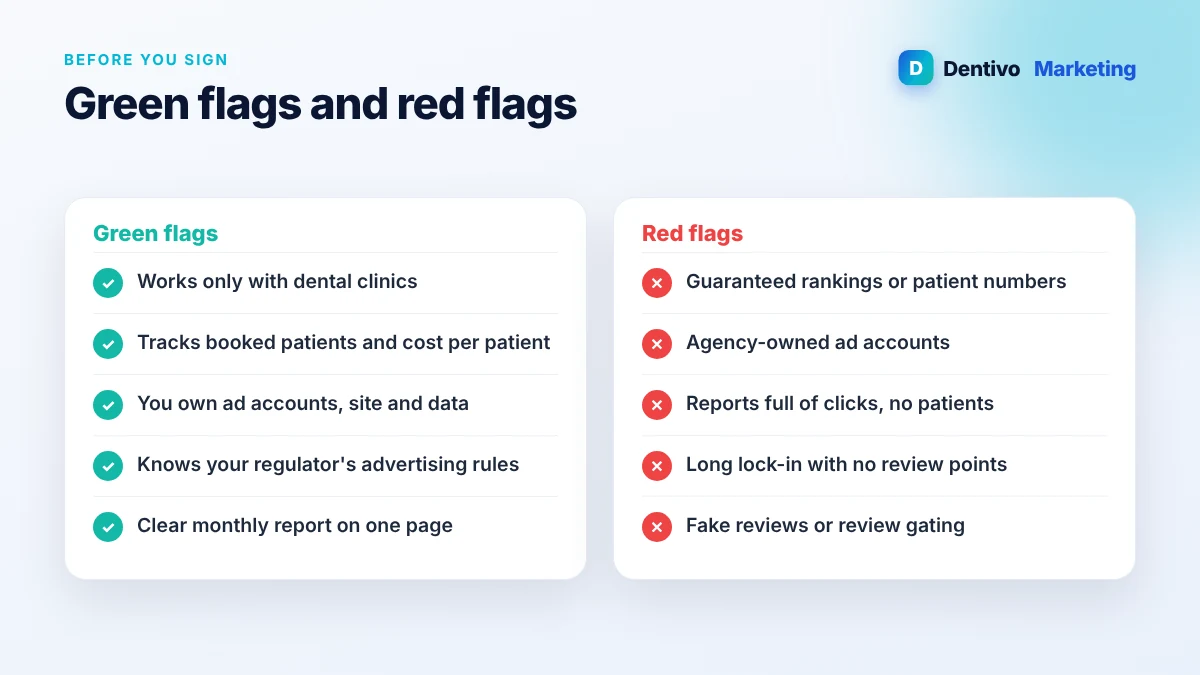
Agencies that work only with dentists have already made the expensive mistakes on someone else’s budget. They know which keywords waste money, which treatments convert and how long implant patients take to decide.
2. Tracking that ends at a booked patient
Ask exactly how they track results. You want call tracking, form and booking tracking, and ideally a connection to your practice data so leads can be matched to real patients.
3. Compliance knowledge
Dental ads are regulated. A good agency knows the rules on testimonials, before-and-after photos and specialist titles in your province, state or country, and builds them into every ad and page.
4. Ownership of your accounts
Your Google Ads account, Meta ad account, Google Business Profile, analytics and website should be in your name. If you part ways, you keep the history and the data.
5. Reporting you can read
A monthly report should fit on a page or two: new patients, cost per new patient, booking rate, what worked and what’s changing. If you need a translator to read it, that’s a problem.
6. Full-funnel thinking
Ads, SEO, website, reviews and follow-up all affect each other. The dental advertising agency you hire should at least understand the whole journey, even if it only handles part of it.
7. Honest timelines
Paid ads in weeks, SEO in months. Anyone promising a fully booked schedule in 14 days is selling hope.
What questions should you ask before hiring a dental marketing agency?
- How many dental clinics do you work with right now?
- How do you define and track a new patient?
- Who will manage my account day to day, and how often will we talk?
- Will I own my ad accounts, website and data?
- What does your monthly report look like? Can I see a sample?
- How do you handle advertising rules in my region?
- Which treatments would you focus on first for my clinic, and why?
- What results should I expect in 30, 90 and 180 days?
- How do you help with call handling and follow-up?
- What are the contract terms, and how do I leave if it’s not working?
Good agencies answer these quickly and specifically. Vague answers to questions 2, 4 and 5 are usually the biggest warning sign.
What are the red flags to watch for?
- Guaranteed rankings or patient numbers before they’ve seen your data.
- Ad accounts owned by the agency, so you lose everything if you leave.
- Reports full of impressions and clicks with no mention of patients.
- Long lock-in contracts with no performance review points.
- No questions about your clinic before sending a proposal.
- Fake reviews or review gating. These can break platform rules and, in the US, FTC rules.
- “Best dentist in the city” style claims that your regulator may not allow.
Dental specialist vs generalist vs freelancer vs in-house: how do they compare?
| Option | Strengths | Weaknesses | Best for |
|---|---|---|---|
| Dental-only agency | Industry playbooks, compliance knowledge, full team | Less flexible for non-dental projects | Clinics focused on new patient growth |
| Generalist agency | Broad skills, often strong at branding | Learns dentistry on your budget, wrong metrics | Brand or design projects |
| Freelancer | Lower overhead, direct contact | One person, gaps in skills, no backup | Small, single-channel tasks |
| In-house marketer | Knows your clinic deeply | Hard to cover ads, SEO, web and CRM alone | Large groups, often alongside an agency |
Many multi-location groups end up with a hybrid: an in-house coordinator who works with a specialist agency. For single clinics, a specialist agency is usually the most practical choice.
What myths do clinics believe about marketing agencies?
Myth: “All agencies do the same thing.”
Two agencies can run the same channels and get very different results. The difference is in campaign structure, tracking, landing pages and follow-up.
Myth: “The cheapest proposal saves money.”
A low fee with no tracking can cost far more in wasted ad spend. Compare proposals on cost per new patient, since the monthly fee is only part of the picture.
Myth: “A dental SEO agency can fix everything.”
A dental SEO agency is great for rankings. If your problem is slow follow-up or a site that doesn’t book, you’ll need help there too.
Myth: “If results are slow, the agency is failing.”
Judge progress against the timeline you agreed on at the start. SEO takes months, and paid ads need a few weeks of data before they settle.
How do you compare agency proposals side by side?
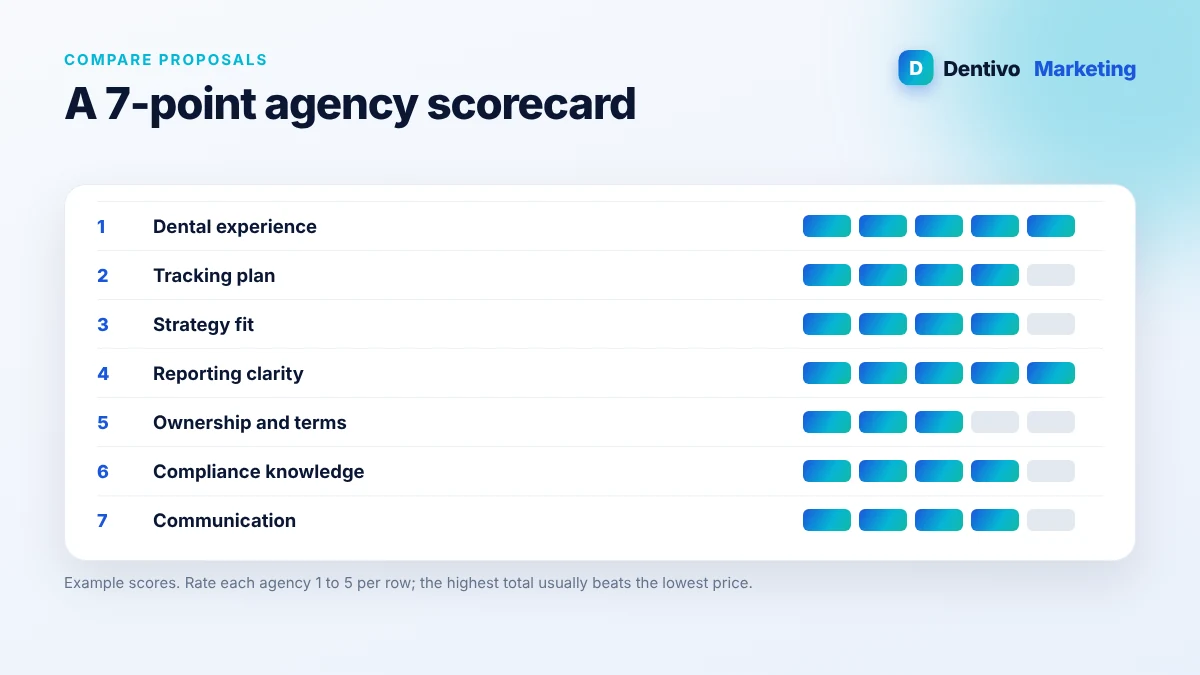
Use a simple scorecard. Rate each agency from 1 to 5 on these points:
- Dental experience: number of dental clients, case studies, treatment knowledge.
- Tracking plan: how leads become measured patients.
- Strategy fit: whether the plan matches your goals and capacity.
- Reporting: clarity and frequency.
- Ownership and terms: who owns what, and how easy it is to leave.
- Compliance: how they handle your regulator’s rules.
- Communication: response times and a named account manager.
Add up the scores. The highest total usually beats the lowest price.
What does a good monthly report from a dental agency look like?
A good report answers 4 questions in the first minute: how many new patients came in, what each one cost, which treatments and channels produced them, and what changes next month.
Here’s what we’d expect to see on page one:
- New patients by source (Google Ads, Meta, organic search, map pack, referrals).
- Cost per new patient for each paid channel, with the trend over 3 to 6 months.
- Lead to booking rate, plus notes on missed calls if there were any.
- Results for priority treatments like implants or Invisalign, listed separately.
- Map pack visibility and review growth.
- A short list of tests and changes planned for next month.
Everything else (impressions, click-through rate, keyword lists) can sit in an appendix. It’s useful for the agency. It’s rarely what a clinic owner needs to make a decision.
How involved should your clinic be?
More than you might think, at least at the start. Your agency needs about an hour a month of your time, plus quick answers on things like treatment priorities, new photos and schedule changes.
The biggest thing your team controls is the phone. We usually suggest a short call script, a 5-minute callback rule for web leads, and a weekly check of missed calls. Clinics that do those 3 things tend to get far more from the same ad budget.
What should the first 90 days with a new agency look like?
- Weeks 1 to 2: audit, goal setting, tracking setup and account access.
- Weeks 3 to 4: paid campaigns live, website quick fixes, review system started.
- Month 2: first full report, search term cleanup, landing page tests.
- Month 3: budget shifted toward the best treatments, SEO content rolling out, clear trend on cost per new patient.
By day 90 you should know which campaigns are profitable and what the agency plans next. If you don’t, ask why.
Where Dentivo Marketing fits
Dentivo Marketing is a specialized dental marketing agency helping clinics in Canada, the USA and the UK attract high-value patients through strategy based on real booking data. We’ve worked with 240+ clinics across those 3 countries, and our focus is filling dental chairs consistently.
Our core services are Paid Advertising (Google and Meta campaigns), Local SEO, Conversion Websites, Reputation Management, Lead Nurturing and CRM, and Analytics and Reporting. We focus on high-value patient marketing for implants, orthodontics and cosmetic dentistry, and we report patient growth in plain, measurable numbers.
We also know the local rules. Our Canadian campaigns are CDCP-aware, our UK work follows GDC guidance, and our US campaigns respect state board and FTC requirements. Clinics keep ownership of their accounts and data.
If you’re comparing agencies right now, we’re glad to answer the 10 questions above on a free, no-obligation growth call. Visit dentivomarketing.com or email hello@dentivomarketing.com to set one up.
A note on results: results from any agency depend on your market, competition, budget, clinic capacity and how enquiries are handled. Use proposals and case studies as a guide, and expect results to vary between clinics.
Frequently asked questions
How do I know if my current dental marketing agency is working?
Check 3 numbers each month: new patients, cost per new patient and booking rate from leads. If your agency can’t report those, or the trend has been flat for 6 months without a clear plan, it’s time for a review.
Should a dental marketing agency guarantee results?
Be careful with guarantees. Agencies can commit to work, tracking and reporting standards, but patient numbers depend on factors like competition, budget and how your team handles calls.
Is it better to hire a local agency or a remote one?
Location matters less than dental experience and knowledge of your market’s rules. A remote, dental-only agency that knows your region’s regulations is often a better choice than a local generalist.
How long should a dental marketing contract be?
Many clinics prefer shorter terms or clear review points every 3 months. Paid ads need 2 to 3 months to settle and SEO needs 6 months or more, so very short trials can be hard to judge.
What does patient acquisition for dentists include?
Patient acquisition for dentists covers every step from the first search to the first appointment: ads, local SEO for dental clinics, the website, reviews, follow-up and tracking. Good dental website conversion and fast follow-up often matter as much as traffic.
Conclusion
The best agency for your clinic is the one that knows dentistry, tracks booked patients and lets you own your data. Use the questions and scorecard here to compare proposals on substance. Choose well, and you’ll grow dental practice marketing results steadily without guessing where your budget went.